
Hing for Institutional Kitchens: Uses, Consistency and B2B Sourcing
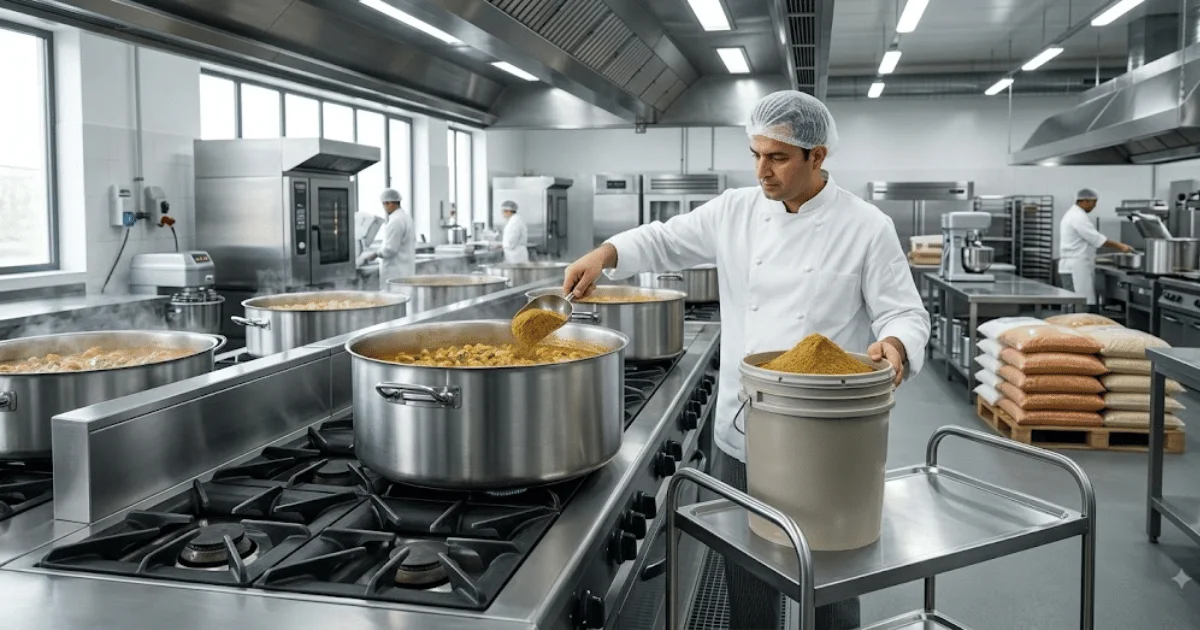
Hing for Institutional Kitchens can play a useful role in large-scale food preparation where consistent flavor, standardized recipes, controlled ingredient usage, and dependable supply are important. Institutional kitchens may prepare food for schools, hospitals, hostels, corporate cafeterias, community programs, religious organizations, canteens, and other large food-service operations.
Unlike a household kitchen, an institutional kitchen may prepare hundreds or thousands of servings every day. That means even a small seasoning variation can affect a large number of meals.
For this reason, Hing should be selected and managed as part of the kitchen’s ingredient-control system rather than treated as an informal seasoning purchase.
Why Hing Matters in Institutional Kitchens
Hing for Institutional Kitchens can contribute a recognizable savory aroma to suitable dal, vegetable preparations, lentil dishes, gravies, and other Indian food applications.
Institutional kitchens often rely on standardized recipes because several cooks may prepare the same food across different shifts or locations.
A consistent Hing product and defined dosage can help support that standardization.
The goal is not to make every dish strongly aromatic. The goal is to maintain the intended flavor profile efficiently and consistently.
What Is an Institutional Kitchen?
An institutional kitchen is a food-production operation that prepares meals for a defined group or organization rather than primarily serving individual household consumption.
Examples include:
- School kitchens
- Hospital kitchens
- Hostel kitchens
- College cafeterias
- Corporate cafeterias
- Factory canteens
- Community kitchens
- Religious kitchens
- Large residential facilities
- Institutional catering operations
These kitchens often operate with structured procurement, defined menus, production schedules, and ingredient budgets.
Why Ingredient Consistency Is Important
Institutional kitchens may serve the same menu repeatedly.
If the Hing product or dosage changes, the flavor of the food can change as well.
For a kitchen serving a large number of people, inconsistency can become noticeable quickly.
Using an approved Hing specification helps reduce unnecessary variation.
Hing in Institutional Dal Preparation
Dal is one of the most practical applications for Hing in large-scale kitchens.
A standardized dal recipe can specify the required Hing quantity for a defined batch size.
The kitchen team can then scale the recipe according to the number of servings while maintaining the same ingredient ratio.
This approach is more reliable than estimating Hing by eye.
Hing in Institutional Vegetable Cooking
Vegetable dishes can have different flavor profiles depending on the ingredients and regional cooking style.
Hing may be appropriate in selected preparations where it complements the seasoning system.
The dosage should be established through the kitchen’s approved recipe.
Hing in Lentil-Based Foods
Lentil and pulse-based foods can work well with aromatic seasoning.
Institutional kitchens preparing large quantities should use measured Hing quantities to maintain consistency between batches.
This is especially important when different cooks are responsible for production.
Hing and Recipe Standardization
A standardized recipe should specify more than the final quantity of food.
It can also define the quantities of major spices and seasonings, including Hing where appropriate.
A recipe sheet may specify:
- Batch size
- Number of servings
- Hing quantity
- Oil or ghee quantity
- Major spices
- Cooking sequence
- Expected preparation time
This creates a practical reference for kitchen staff.
How Much Hing Should Institutional Kitchens Use?
There is no universal quantity that applies to every institutional kitchen.
The correct dosage depends on the Hing product, formulation, batch size, recipe, and desired aroma.
The kitchen should establish its dosage through a tested recipe and then scale it according to production volume.
Using the same approved product is important because changing the product can change the required quantity.
Why More Hing Is Not Always Better
Hing has a strong aromatic character.
Adding more Hing does not automatically improve a dish.
Excessive use can overpower vegetables, lentils, spices, oil, ghee, or other ingredients.
For Hing for Institutional Kitchens, controlled dosage is therefore more useful than maximum aroma.
Hing and Large-Scale Tempering
Many institutional kitchens use tempering for dal, vegetables, and other preparations.
The process may involve heating oil or ghee, adding spices, introducing Hing, and incorporating the tempering into the main preparation.
Because large quantities are involved, the process should be standardized.
Why Temperature Control Matters
Hing can react quickly when exposed to heat.
Excessive heating can affect the desired aroma.
Kitchen staff should therefore follow a consistent tempering procedure rather than adding Hing at an uncontrolled temperature.
Hing for School Kitchens
School kitchens may prepare meals for large numbers of students within a defined budget and schedule.
Consistent recipes can help kitchen teams manage both ingredient consumption and food quality.
Where Hing is part of the approved recipe, measured dosing can make daily production more predictable.
Hing for Hospital Kitchens
Hospital food-service operations can involve multiple menus and dietary requirements.
Ingredient selection should always follow the institution’s approved recipes and dietary policies.
Where Hing is suitable for a particular preparation, standardized usage can help maintain consistency across meal production.
Hing for Hostel and College Kitchens
Hostels and educational institutions may prepare several meals every day.
Large meal volumes make ingredient planning important.
A standardized Hing quantity for each approved recipe can help reduce variation between cooking shifts.
Hing for Corporate Cafeterias
Corporate cafeterias often serve large employee populations during fixed meal periods.
Kitchen teams need to produce food efficiently while maintaining consistent taste.
Using standardized seasoning quantities can support repeatable production.
Hing for Factory Canteens
Factory canteens may prepare meals for employees across several shifts.
This creates a requirement for consistent recipes even when food is produced at different times of the day.
An approved Hing specification can help kitchens maintain a similar flavor profile across production cycles.
Hing for Community Kitchens
Community kitchens may prepare meals for large groups, sometimes under strict cost and supply constraints.
Measured ingredient usage can help the kitchen maintain predictable consumption.
When Hing is used, standardization can prevent unnecessary overuse while maintaining the intended recipe.
Hing and Food Cost Control
Institutional kitchens often work with fixed food budgets.
Hing is used in relatively small quantities, but uncontrolled dosing across thousands of servings can still create unnecessary consumption.
Standardized measurement helps kitchens control ingredient usage.
Why Measuring Hing Matters
Visual estimation can vary between cooks.
One cook may use a small pinch while another may use significantly more.
When multiplied across daily production, these differences can become meaningful.
A measured quantity provides greater control.
Choosing the Right Hing Format
Institutional kitchens may consider different Hing formats depending on their preparation method.
- Hing Powder
- Compound Hing
- Hing Granules
- Other suitable commercial formulations
The best option depends on the kitchen’s storage, dosing, preparation process, and procurement requirements.
Hing Powder for Institutional Kitchens
Hing Powder can be convenient where a fine ingredient is required for tempering or seasoning.
It can be measured in controlled quantities and incorporated into suitable recipes.
Storage should be managed carefully to protect the product from unnecessary moisture exposure.
Compound Hing for Institutional Foodservice
Compound Hing can be considered where kitchens require a commercially formulated product for regular food preparation.
The appropriate product should be selected according to the kitchen’s recipe and expected application.
Before changing suppliers, the kitchen should test the replacement product in its standard recipes.
Hing Granules for Institutional Applications
Hing Granules have different physical properties from fine powder.
Depending on the preparation process, granules may offer different handling characteristics.
The kitchen should select the format that fits its dosing and storage process.
How to Test a New Hing Product
Institutional kitchens should avoid replacing an approved Hing product without testing.
A practical test can compare the existing product and the new sample in the same recipe.
The team can evaluate:
- Raw aroma
- Cooked aroma
- Dosage
- Flavor contribution
- Handling
- Storage behavior
- Overall food quality
Why Application Testing Is Better Than Raw Smell Testing
The raw aroma of Hing can be very strong.
However, the important question for an institutional kitchen is how the ingredient performs after cooking.
A product that smells strong before use may not necessarily provide the best result in the finished food.
Application testing provides a more practical basis for selection.
Hing Storage in Institutional Kitchens
Institutional kitchens may open the same ingredient repeatedly throughout the day.
The main container should therefore be kept properly sealed whenever the product is not being used.
Only the amount required for regular kitchen use should be exposed unnecessarily.
Why Moisture Protection Matters
Powdered ingredients can be affected by moisture.
Institutional kitchens often have steam, heat, and frequent cleaning activity, so storage practices matter.
Hing should be stored in a suitable dry location according to supplier recommendations.
Hing Procurement for Institutional Kitchens
Large kitchens need a predictable procurement system.
The purchasing team should consider monthly consumption, menu cycles, storage capacity, supplier lead time, packaging, and expected changes in meal volume.
This is more reliable than ordering Hing only after the existing stock becomes low.
What Institutional Buyers Should Ask a Hing Supplier
- What Hing formats are available?
- What pack sizes are available?
- Can bulk quantities be supplied?
- Can the same specification be maintained across repeat orders?
- What storage conditions are recommended?
- Can samples be provided?
- What quality documentation is available?
- What is the expected delivery timeline?
These questions help procurement teams evaluate whether the supplier fits their operational requirements.
Why Consistent Supply Matters
An institutional kitchen cannot easily change its recipes every time an ingredient becomes unavailable.
Supply continuity therefore matters.
A reliable Hing supplier can help the kitchen maintain its approved recipe and avoid unnecessary changes in flavor.
Hing Procurement for Multiple Locations
Organizations operating several kitchens may benefit from centralized procurement.
Using the same approved Hing product across locations can simplify recipe standardization and quality control.
It can also make purchasing and inventory management easier.
Hing and Central Kitchen Operations
Central kitchens prepare food that is distributed to multiple locations.
In these operations, consistency becomes particularly important because one production batch may serve many outlets.
The Hing specification should therefore be included in the central kitchen’s approved ingredient list where applicable.
Why Institutional Kitchens Need Approved Ingredients
Large food-service organizations benefit from documented ingredient standards.
An approved ingredient list can define the product type, supplier, packaging, and required specification.
This reduces the chance of unplanned substitutions.
Creating a Hing Standard Operating Procedure
A simple Hing SOP can specify:
- Approved Hing product
- Approved dosage
- Recipe or application
- Measurement method
- Storage conditions
- Handling instructions
- Supplier details
- Replacement approval procedure
This makes the ingredient easier to manage across different kitchen teams.
Hing and Kitchen Staff Training
Staff training is another important part of consistency.
Kitchen employees should understand that Hing is a concentrated ingredient and that dosage should follow the approved recipe.
This reduces the risk of excessive or inconsistent use.
Common Hing Mistakes in Institutional Kitchens
- Adding Hing without measuring
- Using different products across shifts
- Changing suppliers without recipe testing
- Storing Hing near steam or heat
- Ordering only when stock is almost finished
- Using one dosage for every recipe
- Failing to document the approved product
- Allowing individual cooks to change the formulation
How to Improve Hing Management
- Select an approved Hing product.
- Test it in the actual recipes.
- Define the dosage for each application.
- Document the recipe.
- Train kitchen staff.
- Store the product correctly.
- Monitor consumption.
- Forecast future requirements.
- Review supplier performance.
Why Price Should Not Be the Only Procurement Factor
Institutional kitchens often operate under tight budgets, but the lowest purchase price is not always the best option.
A product that requires inconsistent dosage or creates flavor variation can increase operational problems.
Procurement teams should consider consistency, application performance, packaging, supply reliability, and total usage cost.
Calculating Practical Hing Cost
Instead of looking only at the price per kilogram, buyers can consider the cost of Hing used per defined quantity of food.
This provides a more useful comparison between different products.
A product with a higher purchase price may still be commercially practical if it performs consistently at the required dosage.
Hing for Institutional Catering Contractors
Some institutions outsource food preparation to catering contractors.
In such cases, the contract or food specification may define the required ingredients and quality standards.
A standardized Hing product can help the contractor maintain the agreed food profile.
Hing for Large Meal Programs
Large meal programs require predictable ingredient consumption.
Even small differences in seasoning can become significant when multiplied across thousands of servings.
Recipe standardization and measured Hing usage can therefore support operational control.
RB Industries for Institutional Hing Supply
RB Industries manufactures and supplies Asafoetida, Compound Hing, Hing Powder, and Hing Granules for food businesses, restaurants, hotels, caterers, food manufacturers, wholesalers, distributors, FMCG brands, private-label businesses, and exporters.
Institutional food-service buyers can discuss their intended application, preferred Hing format, packaging requirements, estimated consumption, and supply schedule.
Commercial buyers can evaluate samples in their approved recipes before moving to regular procurement.
Planning Long-Term Hing Supply
Institutional kitchens with predictable meal volumes can create a regular Hing procurement schedule.
Consumption data from previous months can help purchasing teams forecast future requirements more accurately.
This can reduce emergency orders and make inventory management more predictable.
Conclusion
Hing for Institutional Kitchens is not simply a seasoning choice. In large food-service operations, it becomes part of recipe standardization, ingredient control, procurement, storage, and quality management.
Schools, hospitals, hostels, corporate cafeterias, factory canteens, community kitchens, central kitchens, and catering contractors can benefit from using an approved Hing product with a clearly defined dosage. This helps reduce variation when large numbers of meals are prepared by different kitchen teams.
The best approach is to test the Hing in the actual recipe, document the approved product and quantity, train staff, store the ingredient correctly, and maintain a reliable procurement schedule. Price should be considered alongside consistency, application performance, supply reliability, and total usage cost.
RB Industries supplies Asafoetida, Compound Hing, Hing Powder, and Hing Granules for commercial food-service applications. Institutional kitchens and food-service organizations can discuss their product requirements, packaging, consumption levels, and supply schedules to develop a suitable Hing procurement arrangement.
Frequently Asked Questions
Why is Hing useful in institutional kitchens?
Hing can contribute savory aroma to suitable recipes such as dal and vegetable preparations. In institutional kitchens, standardized Hing usage can also help maintain consistent flavor across large production volumes.
How much Hing should an institutional kitchen use?
The quantity depends on the recipe, Hing product, batch size, and desired flavor profile. The kitchen should establish an approved dosage through recipe testing and use that specification consistently.
Which Hing format is suitable for institutional foodservice?
Hing Powder, Compound Hing, and Hing Granules can serve different applications. The appropriate format depends on the kitchen’s preparation method, dosing process, storage conditions, and procurement requirements.
Should institutional kitchens test a new Hing supplier?
Yes. A new Hing product should be tested in the actual recipes before replacing an approved ingredient. This allows the kitchen team to compare aroma, flavor, dosage, and handling performance.
How can institutional kitchens control Hing consumption?
Use standardized recipes, measured quantities, trained kitchen staff, and regular inventory monitoring. Forecasting consumption from actual meal production can also improve procurement accuracy.
Can RB Industries supply Hing to institutional kitchens?
RB Industries supplies Asafoetida, Compound Hing, Hing Powder, and Hing Granules for commercial food applications. Institutional buyers can discuss their application, quantity, packaging, and regular supply requirements.


